Cart 0
From Farm to Flame: How Premium CigarsAre Made
When you light a premium cigar, you’re not just burning tobacco. You’re setting fire to years of work,
centuries of tradition, and an extraordinary amount of human skill that most people never think about.
From the moment a tobacco seed goes into Cuban or Dominican soil to the second you clip the cap
and bring a flame to the foot — that cigar has passed through dozens of hands. Each pair of hands
did something specific, something essential. Let’s trace that entire journey, because understanding it
changes how you experience the smoke.
It Starts With the Seed
Premium cigar tobacco isn’t grown from just any seed. The Habanos brands — Cohiba, Montecristo,
Partagas — use seeds that have been carefully selected, refined and protected over generations. The
specific seed strains used in Cuba’s Vuelta Abajo region are among the most prized agricultural genetics
on the planet. The seeds are germinated in seedbeds under protective netting. Within three to four weeks, they’re seedlings. After six to eight weeks, they’re transplanted to the main growing fields — and the real work begins.
Growing Conditions That Can’t Be Replicated
Cuba’s Pinar del Rio province, particularly the Vuelta Abajo region, has a combination of soil chemistry,
humidity, temperature and rainfall that is unique on Earth. The reddish clay soil there has a mineral
composition — particularly its iron content — that contributes to the distinctive flavour of Cuban wrapper
and filler tobacco in ways that scientists have studied and still can’t fully explain. Shade-grown wrapper
tobacco — grown under muslin tents called tapados — develops larger, thinner, more oily leaves with
fewer veins. These become the silky, beautiful wrappers you see on the outside of a finished cigar.
Sun-grown tobacco, by contrast, develops thicker, more flavourful leaves used for filler and binder. The
growing cycle takes roughly three months. Three months in the field, under constant human supervision.
Harvesting — One Leaf at a Time
Tobacco leaves aren’t harvested all at once. They’re picked leaf by leaf, from the bottom of the plant
working upward, over a period of several weeks. The reason? Leaves at different heights on the plant
have different flavour profiles and nicotine levels. Bottom leaves are lighter and mild. Top leaves are
powerful, oily and full. Each position on the plant has a name and a designated purpose in the final blend.
Skilled harvesters can identify exactly which leaf is ready at which moment. It’s not a job for machines. It’s
a job for experienced eyes and experienced hands.
Curing, Fermentation and Ageing
Freshly harvested tobacco doesn’t taste like a cigar yet. It tastes green and raw. The transformation
happens through curing and fermentation — a process that takes months to years. Air-curing happens in
long wooden barns called casas de tabaco. Leaves hang from rafts and dry slowly over six to eight weeks,
losing moisture and beginning chemical transformation. Then comes fermentation: leaves are stacked in
large piles called pilones where heat builds naturally from the decomposing organic matter. The
temperature is monitored daily. When it rises too high, the pilone is broken apart and restacked. This
process burns off harsh compounds and develops the complex flavours you eventually taste. The finest
tobacco is then aged further in bales or cedar-lined rooms — sometimes for years — before it’s considered ready for rolling.
Rolling — The Human at the Heart of It All
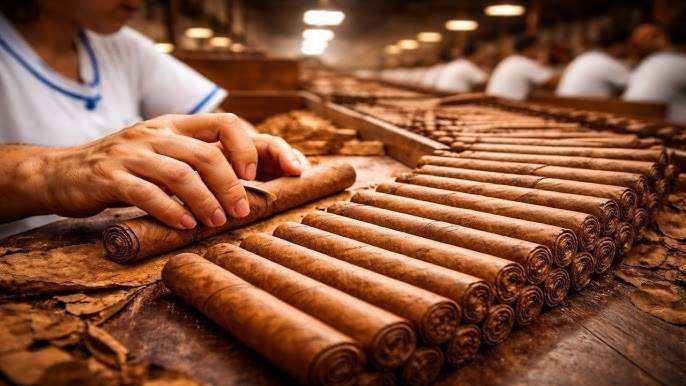
In a Havana factory — a fabrica — you’d walk into a vast hall of men and women seated at wooden
benches called burros. Each roller is called a torcedor. Each torcedor is trained for years, often a decade
or more, before they’re trusted to roll the most prestigious vitolas. Rolling a cigar involves three
components: the filler (multiple different leaf types folded together), the binder (a leaf wrapped around the filler to hold its shape), and the wrapper (the single, perfect leaf that becomes the exterior). Getting the density, shape and draw just right is extraordinarily difficult. Most cigar factories have rollers who
specialize in specific sizes — they roll thousands of the same vitola every day. A finished cigar is then put
through quality control: the draw is tested with a specialized tool, the construction is inspected visually, and then the cigars go to the ageing room for a period of final rest before boxing.